The Wedding Pricing Strategy Guide is about understanding the scope of pricing in the wedding industry in order to best price your services strategically. This means that there are two scopes to this article:
To give an understanding of pricing options for services.
To understand the best practices for pricing your services now as well as in the future.
Pricing your services has no simplistic answer but instead dives into the depths of economics, what it means to be a brand, one's own cognitive biases, as well as the practical outcomes of whether or not to list prices on your website.
This article seeks to lay out a map for those who are seeking to understand the territory so that, as they work through their own entrepreneurial journey, pricing services and the strategies behind pricing become ever more clear.
As a brand strategist and web designer in the wedding industry, it is my hope that this article helps others understand more deeply the terrain that lies in front of them.
Key Takeaways
Wedding professionals generally price their services using cost-plus pricing, value-based pricing, dynamic pricing, or a combination of these strategies.
The value stick helps explain pricing through three components: the cost to provide a service, what a client is willing to pay, and the value the client feels they received.
Wedding professionals must be aware of their own internal reference bias so that their personal experience with money does not determine what they believe their services can be worth.
Client experience itself can create additional value beyond the functional service being provided.
As wedding professionals move from accessible to premium and luxury tiers, signature style, expertise, scarcity, client experience, brand recognition, and social clout increasingly influence price.
Whether or not a wedding professional should list prices on their website depends on their pricing philosophy, positioning, clientele, and how customized their service is.
What is the basic economic theory behind pricing wedding services?
The basic economic theory behind pricing wedding services can be understood through the value stick, which includes cost, price, and value.
The value stick is comprised of three bars:
What a service costs the service provider.
What a customer is willing to pay.
The value that the customer feels they received.
It is in these three lines of economics that every transaction takes place. It is the foundation upon which every wedding service is placed regardless of whether or not it is known or articulated.
Credit: Harvard Business School
Therefore, for our purposes within the wedding industry, the three lines of the value stick consist of:
How much it costs you to provide your service (expenses, payroll, etc.).
How much a client is willing to pay for your services.
How much your client feels they received as a result of purchasing your services.
The goal of every business is to create the widest margins between all of these lines. What I mean by that is that every wedding professional should seek the lowest cost to provide their service, the highest price for their services, and for the client to feel that the value they received far outweighs the price they paid.
This leads us to three philosophies of pricing your services.
What are the philosophies of pricing your services?
There are three main philosophies of pricing services: cost-plus pricing, value-based pricing, and dynamic pricing.
Cost-Plus Pricing
Cost-plus pricing is a calculation of what it costs you to provide your service plus what you believe to be a reasonable margin.
Determine the cost it takes for you to provide your services and then add what you feel to be an appropriate margin of profit to that number. For example, you're a wedding planner who would like to make six figures a year, you can take on 15 weddings, and you know how much it will cost you in expenses to provide that service. You therefore charge an amount per wedding that allows you to reach that desired income.
Value-Based Pricing
Value-based pricing is a determination of what value your services provide a client and charging accordingly.
Determine the cost of your services based on the value that your services provide for the client. I'll use a non-wedding service here as an example because it's more clear: You run a consulting firm that specializes in North American transportation efficiency. You know that by implementing your strategies, your client can save 2% on costs per year, which totals $2 million per year. You charge $200,000 for 40 hours of training and system training, which is 10% of first-year savings to the company.
This is not based on your cost plus whatever margin you feel is reasonable, but instead on what value it provides to the client.
Dynamic Pricing
Dynamic pricing is the variability of pricing your services depending on the supply and demand cycles of your services.
Often seen in the airline and hospitality industries, what you pay is dynamic as it changes based on timing.
For example, you are a wedding videographer who historically has had the highest number of inquiries for June and July. You therefore price your services higher during these months. During the shoulder seasons of April-May and August-September, you price at a lower rate, and during the off-season, you charge at your lowest rate.
Synthesizing & Applying
In order to determine the pricing for your services, you must determine which pricing strategy you would like to employ.
Cost-plus pricing works best for businesses seeking to appeal to the broadest number of people with the understanding that, if the margin is high enough, they will turn the profit they desire. These will be the people who know what they want to make in a year and then price according to what will be a sufficient margin for them to receive the profit they desire.
Value-based pricing works best for businesses that are seeking to leverage their experience and expertise to ensure an outcome for their clients. Oftentimes, value is determined in the wedding industry by things like a signature style that only you are capable of, client experience, and risk mitigation for your client (i.e., your experience and expertise provide greater confidence in their desired outcome). Knowing your clientele, their desired outcomes, and your suitability to provide them with a solution is your greatest lever in value-based pricing.
Dynamic pricing in the economic world is used both with cost-plus pricing, as we've seen recently with Uber and Instacart, as well as value-based pricing. Dynamic pricing is used by wedding professionals who understand both the seasonality of the market as well as supply and demand.
What is internal reference bias in pricing services?
Internal reference bias in pricing services is the tendency to use your own experience with prices as an anchor for what you believe you should charge for your services.
This bias is based on the price of the good or service. It is based on the mental math of:
How much money we have.
How much we've seen something cost in the past.
How much the good or service costs.
For example, an individual makes $150,000 a year. The last time they looked at vehicles, the average cost was $28,000. They go to a car dealership and see that the average vehicle costs $50,000. They conclude that the $50,000 vehicle is too expensive and will purchase second-hand.
Another individual was raised in a household with supercars, has a yearly income of $10 million, goes to the car dealership, and purchases a Mercedes G-Wagon for their teenage son without a second thought.
In each of these situations, there is a price-based bias that influences what is a valid price.
Oftentimes, wedding vendors tend to price their services based on their own price bias: how much they would be able to spend on a vendor within their category and how much they've seen other vendors like them charge.
For someone to charge 5–10X or more than their pricing does not have a category in their mind. Therefore, wedding professionals must be aware of their own and their client's price-based bias when pricing their services.
What is the experience economy in pricing services?
The experience economy is the added value that comes from the experience surrounding the service you provide. The experience, not simply the function of the service, becomes a part of its value and therefore its pricing.
For example, you purchase a $50 perfume from a local Nordstrom. Functionally, you've purchased something that smells good.
However, for the experience, you walk into a Chanel fragrance boutique where you are greeted with water, walked through their experiential fragrance journey, and given recommendations by the associate. You walk out with a $400 bottle of something that smells good.
What differentiates them is the experience.
The experience economy moves beyond even the simple function of what price something has been in the past, how much money you have, and how much the good or service costs. It creates a value that is beyond the components and raw materials themselves, and the experience itself becomes a part of the price.
The experience economy is seen in fine dining, ultra-luxury handbags and watches, and hospitality experiences. The experience becomes a part of the value.
Wedding professionals must be aware of this because oftentimes they do not see these experiences as valuable, likely because they have not experienced them themselves or linked them to their own sense of value (see internal reference bias above). However, these personal experiential biases must be examined and laid aside when determining pricing.
How does branding affect wedding pricing?
Branding affects wedding pricing because clients are not evaluating only the functional service being provided. As a wedding professional moves into premium and luxury tiers, signature style, brand recognition, client experience, reputation, and social clout increasingly become a part of the value a client is purchasing.
This means two wedding professionals can provide services within the same general category while being perceived very differently by the market.
The price a client is willing to pay is therefore not simply determined by the raw deliverables but by the value they perceive in choosing that particular brand to provide them.
Why can one wedding professional charge more than another?
One wedding professional can charge significantly more than another because price is influenced by more than the functional service itself.
Experience, expertise, signature style, scarcity, client experience, brand recognition, risk mitigation, and the clientele a wedding professional serves can all influence what a client is willing to pay.
This is why understanding value-based pricing becomes increasingly important as a wedding professional moves from accessible to premium and luxury tiers.
Does easily accessible pricing devalue?
Easily accessible pricing can place greater emphasis on price rather than on the unique value provided, particularly for premium and luxury services where narrative, artistry, customization, and experience are a significant part of the purchase.
As Kapferer and Bastien state in The Luxury Strategy, there is a difference between the supermarket and the luxury store. In the supermarket, prices are readily available and you are coaxed with promotions, sales, and offers to sweeten the purchase. However, in luxury:
The price is the "exchange value" of a product, but what makes luxury is the "symbolic value." This means that the stronger the symbolic value of a luxury brand, the higher a price it can command… You are left with the impression, rather, that you have wandered into an art exhibition, where objects are displayed, and not a "point of sale."
The price is of secondary consequence. The first is that of the heritage, the craftsmanship, and the narrative behind the piece.
It is in this process of discovery, oftentimes referred to as the discovery call for the wedding professional, that you share the why behind the exceptional piece, which then infuses the good or service itself with greater value.
Additionally, there are times when selling the price detracts from the buyer's experience as it catches them in the detail of cost rather than the narrative and artistry that they are caught up in.
This also means that the purchase of luxury becomes a lengthy act in which relationship, curation to the individual, and catering to their wants and desires are a part of that which is no longer transactional but relational and deeply personal.
What are the price tiers in the wedding industry?
For the sake of simplicity, pricing within the wedding industry can be segmented into three broad tiers: accessible, premium, and luxury.
There are, of course, tiers within tiers of the wedding industry, but these three categories give us a framework for understanding how pricing changes as expertise, value, experience, and brand recognition increase.
Accessible
Within the accessible tier, many vendors are priced at cost-plus. They are still working on their artistry, expertise, brand recognition, and client experience.
They work hard and with many weddings in order to gain their stripes. It's through trial and error that they develop the skills that eventually allow them to move to the next category.
Premium
Within the premium tier, vendors begin to understand value-based and dynamic pricing. They have begun to develop a style, client experience, and brand recognition that positions them in a tier that is established and less risky than an accessible-level vendor. Their experience and expertise pay off, oftentimes locally, as they are seen as one of the top vendors within their geographic location.
Luxury
Within the luxury tier, vendors leverage value-based and dynamic pricing.
Here they are known and desired for their artistic signature style that has earned them a reputation. Their client experience is such that high-net-worth individuals who have a high bar for client experience will not only hire but also refer.
Brand recognition and social clout become a part of pricing at the luxury tier. These vendors have insider information and understand the world of high-net-worth and ultra-high-net-worth individuals in a way that is an asset.
How does luxury wedding pricing differ from premium pricing?
Premium wedding professionals are often valued for established expertise, quality, style, and a strong client experience. Luxury pricing goes further by incorporating desirability, scarcity, signature style, brand recognition, social clout, exceptional client experience, and an understanding of high-net-worth clientele.
As a result, luxury pricing is not simply premium pricing with a higher number attached to it. The value being perceived and purchased by the client has changed.
Should you list your prices on your website?
Whether or not you should list prices on your website depends on your pricing philosophy, positioning, clientele, and the degree to which your service is standardized or customized.
You Should List Your Prices On Your Website If:
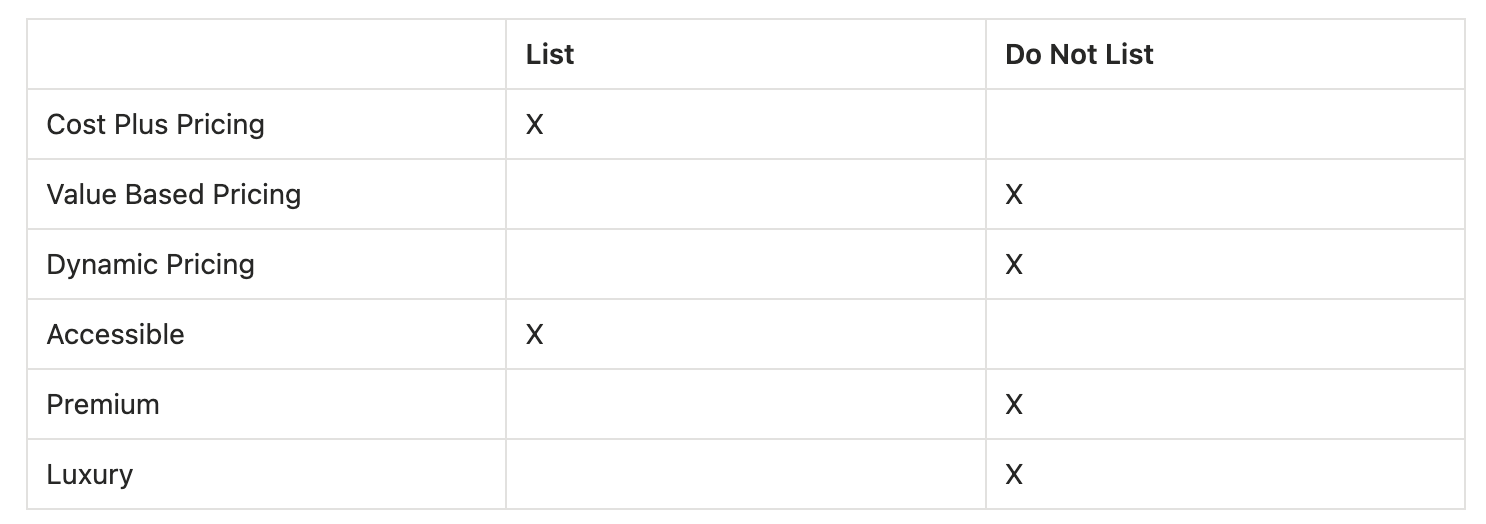
You are cost-plus as a pricing philosophy and you are in the accessible tier.
For those seeking to establish themselves in the marketplace or who enjoy shooting enough to know that if they shoot X number of weddings at X margin, they will make $X.
Best Practices for Listing Prices on Your Website
Create three price tiers that clients can choose from.
Clearly differentiate between what is offered in the tiers.
Showcase how you are priced at a better value than others in your same tier.
You Should Not List Your Prices On Your Website If:
You are value-based, dynamic, premium, and/or luxury.
Signature style, scope of the project, the clientele that you are serving, and the timing of the project all determine the price to the client.
Here, a discovery call with the client along with a customized proposal shows that you are not one of many but that you are the only one who can provide the desired solution to your client.
Frequently Asked Questions About Wedding Pricing Strategy
What are the main pricing strategies for wedding professionals?
The three main pricing strategies discussed in this guide are cost-plus pricing, value-based pricing, and dynamic pricing. Cost-plus pricing begins with cost and adds a desired margin. Value-based pricing considers the value provided to the client. Dynamic pricing changes based on factors such as seasonality, timing, supply, and demand.
What is value-based pricing for wedding professionals?
Value-based pricing determines price based on the value your service provides to the client rather than simply calculating your cost and adding a profit margin. Within the wedding industry, signature style, client experience, expertise, and risk mitigation can all contribute to that value.
How does client experience affect wedding pricing?
Client experience can increase the perceived value of a wedding service beyond its functional deliverables. Personalization, communication, service, curation, and the emotional experience surrounding the service can therefore become part of what the client is willing to pay for.
Should wedding professionals put prices on their websites?
Whether wedding professionals should list prices depends on their pricing philosophy, positioning, clientele, and how standardized or customized the service is. This guide recommends accessible pricing primarily for more standardized, cost-plus services and a discovery-based pricing process for highly customized, value-based, premium, or luxury services.
What makes luxury wedding pricing different?
Luxury wedding pricing includes factors beyond functional quality. Signature style, scarcity, client experience, reputation, brand recognition, social clout, and an understanding of high-net-worth clientele can all become part of the perceived value of the service.
Conclusion
Pricing strategy for wedding professionals continues to be a growing area of development along with luxury pricing strategy. However, this article outlines a rough map for the territory that is pricing wedding services.
Refine your brand and build a website that attracts your dream projects and dream prices. Contact us directly at team@webrise.studio.
Success! We’ll be in touch soon.
Something went wrong while submitting.
Scroll down ↓
( About Us )
I’m Matt, a brand strategist and web designer working exclusively with wedding professionals. I help planners, photographers, and creative teams clarify what they want to be known for and translate that into a website that attracts the clients they actually want. My work focuses on positioning brands for the next tier of their market through strategy, curation, and thoughtful design.

.jpg)
.svg)